
Hand Function & Exercises

This page covers the anatomy behind everyday hand strength and four exercises that target it directly. Understanding which muscles are involved, and what movement each performs, makes it easier to do these movements correctly and to recognize why they matter. We start with a short explanation of the relevant hand muscles before walking through each exercise.

Understanding your hand muscles

Lumbricals: curl the fingers down
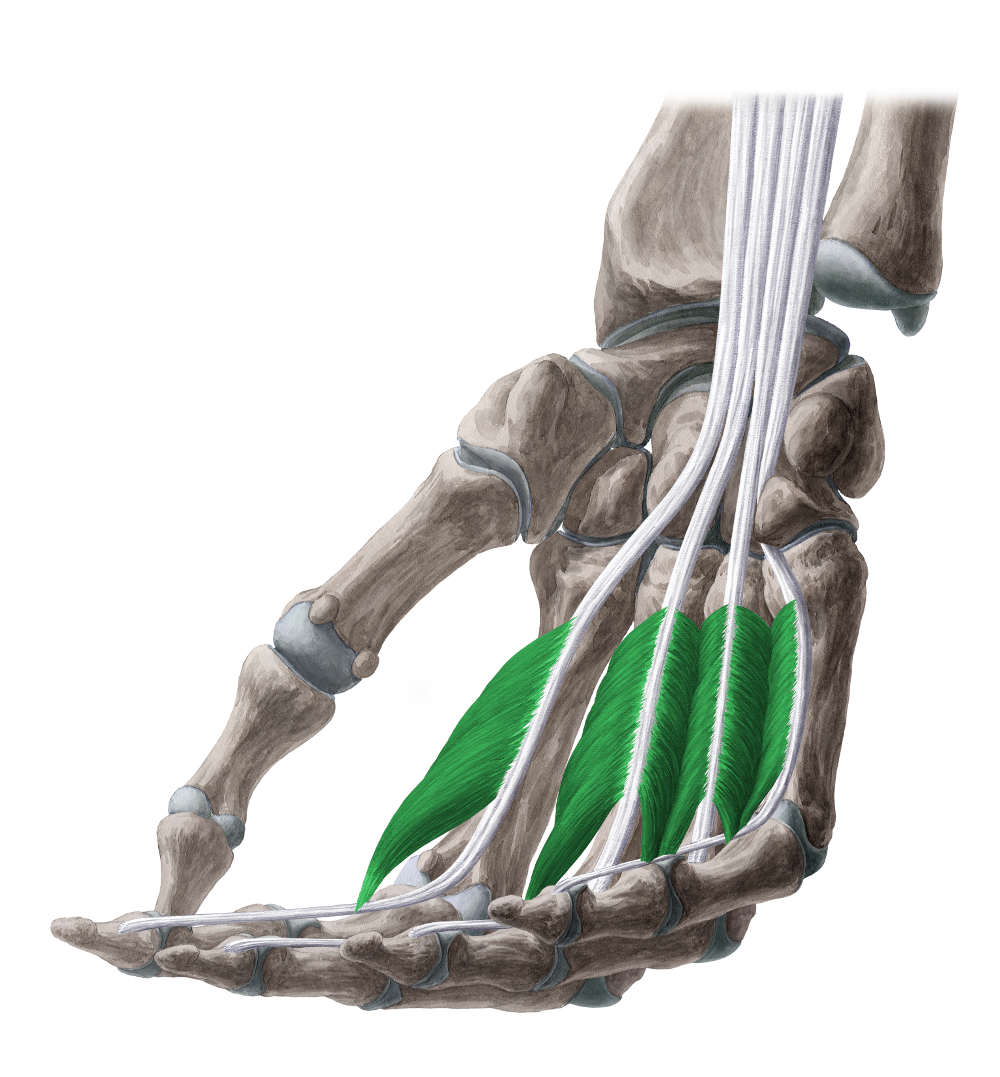
Anatomical illustration of the lumbrical muscles of the hand, highlighted along the fingers.

Dorsal interossei: spread fingers apart
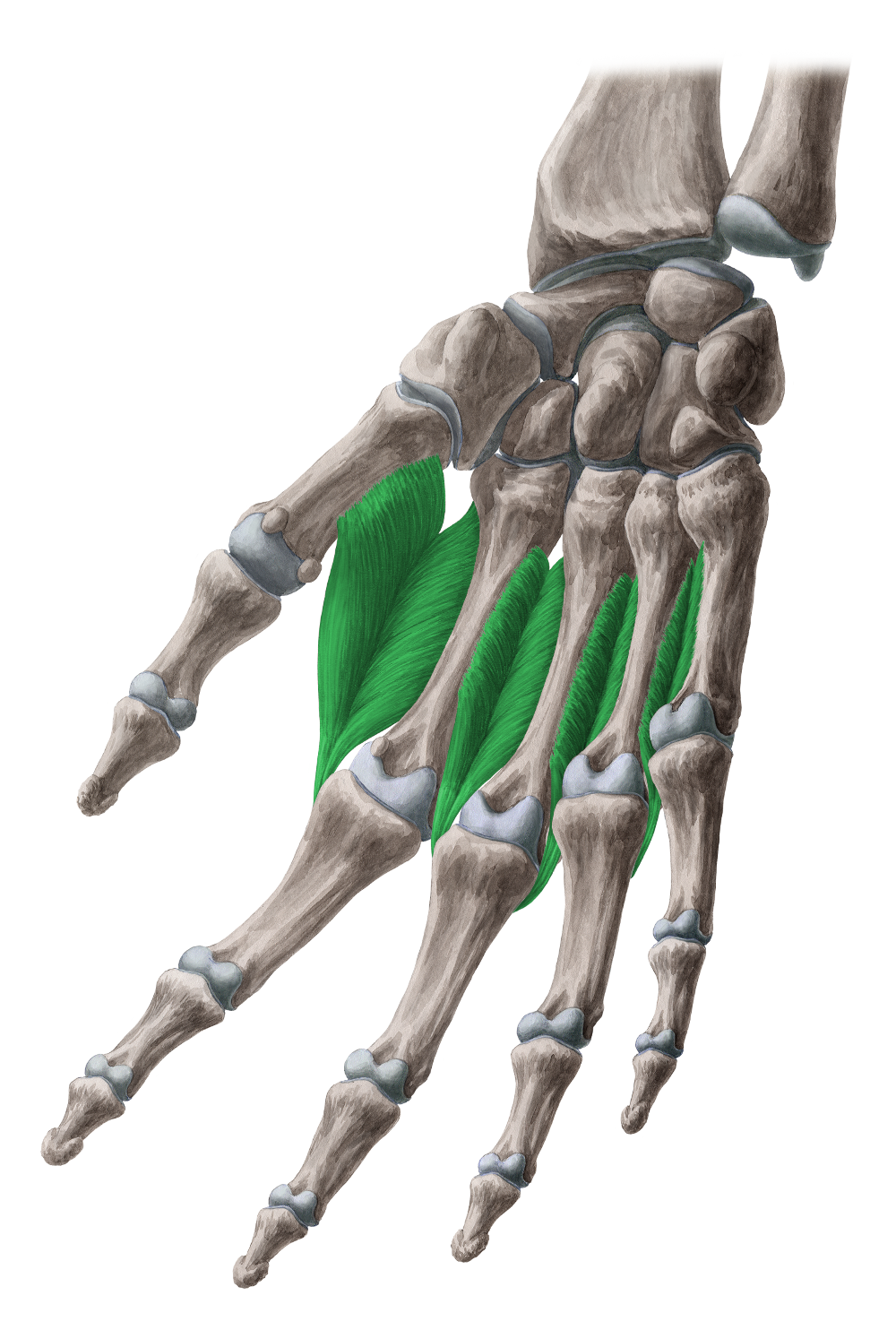
Anatomical illustration of the dorsal interossei muscles on the back of the hand.

Palmar interossei: draw fingers together
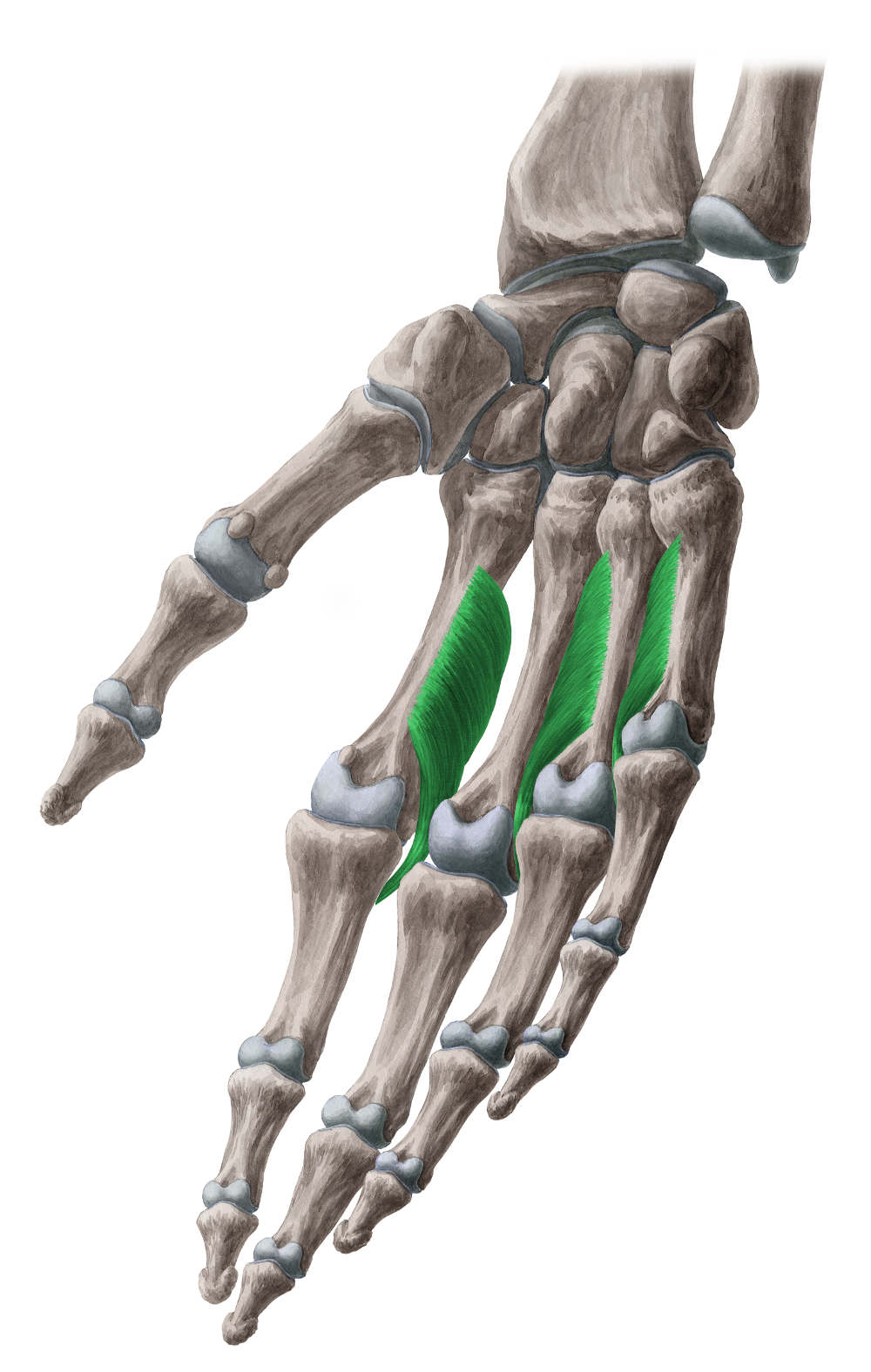
Anatomical illustration of the palmar interossei muscles between the metacarpal bones.

Many of the small tasks your hands do all day — turning a key, buttoning a shirt, picking up a coin — rely more heavily on a set of small muscles that live entirely within the hand itself, called the intrinsic muscles. They're different from the larger muscles in your forearm that move both your fingers and wrists. They're responsible for the fine control and functional coordination that make everyday hand movements feel effortless.

Two of the most important intrinsic groups are the lumbricals and the interossei. Both groups start within the hand, cross over the big knuckles, and attach to the first set of finger bones. The lumbricals pull the fingers downward toward the palm while keeping the fingers straight, and are tuned for precision movements. The interossei spread your fingers apart and draw them back together, helping with positioning and stability. Combined, they enable controlled movements that raw forearm strength can't replace.

The size and location of these muscles is also why hand weakness can be sneaky. Clinicians distinguish between losing muscle mass (sarcopenia) and losing muscle strength (dynapenia) — they don't always move at the same pace, and strength is usually the first to go. Smaller muscles, like the intrinsic muscles of the hand, are often affected first, while most clinical testing focuses on larger muscle groups. The standard grip test, for example, is built around an action that leans heavily on the forearm muscles — so it can miss early intrinsic decline entirely. This is how function can slip before anything shows up on a test.

The exercises below target these specific intrinsic muscles directly, rather than relying on general hand or forearm strengthening.

Want to go deeper on the anatomy? Kenhub's guide to hand anatomy offers a closer look at how these muscles work.

Hand Exercises

A note before you start: none of these exercises should be painful. Some mild fatigue is normal, but pain is not — it's a sign to ease off, not push through. If an exercise doesn't feel right, or if pain persists, reduce the resistance or your range of motion, and speak with your doctor or physiotherapist before continuing. More isn't always better here; doing these to excess can be counter-productive rather than helpful.

Tents

Rest your palms flat on a table, a couch arm, or your lap, fingers straight and together. Without allowing your arm to move or your fingers to bend, slide your fingertips toward your wrist and allow your big knuckles to raise up — like a tent. If you can reach 90 degrees, great, then push your fingertips forward until your palms are again flat.

Start at1 set of 20 reps
Work up to2 sets of 50 reps

Tip: It should feel more like your fingertips are pressing into the surface than your wrist is pulling your hand backward. This exercise is for the hands, not the wrist.

Finger separations

Rest your hand flat on a table, a couch arm, or your lap, fingers straight and together. Keeping your fingers straight and your palm flat, spread two fingers apart as far as you comfortably can, then draw them back together until they're touching again. Repeat for each adjacent pair of fingers in turn. Once this feels smooth, with minimal to no jittering, loop a soft rubber band around each pair to add resistance.

Start at1 set of 5 reps per finger-pair
Work up to2 sets of 20 reps per finger-pair

Tip: Make sure both fingers are moving outwards. If one "just won't move," either help it along with your other hand or remove the band entirely and practice the motion first without resistance.

Inter-finger squeezes

Rest your hand flat on a table, a couch arm, or your lap, fingers straight and slightly spread. Place a small piece of foam between two adjacent fingers, then squeeze the fingers together around it before releasing back to the spread position. Repeat for each adjacent pair of fingers in turn.

Start at1 set of 5 reps per finger-pair
Work up to2 sets of 20 reps per finger-pair

Tip: Try shifting where the foam sits along your fingers — closer to the base, closer to the tip, or somewhere in between. It can feel different depending on placement, so it's worth finding the spot that feels best for you.

Putty work

Roll the putty into a rough ball. Grip it with your entire palm and fingers, squeezing until your hand is fully closed, then release and re-roll it into a ball.

Start at1 set of 5 squeezes
Work up to2 sets of 10 squeezes

Tip: Don't let your fingers twist off-axis. Squeeze only hard enough that your fingers stay aligned, and don't hesitate to use your other hand to help hold your fingers in position. If this is difficult, get a softer putty or squeeze more slowly.

How it fits into your day

A woman relaxing on a couch in a bright, comfortable living room.

Once you've got the movements down, a full set of exercises takes about 10 minutes — closer to a quick break than a workout. There's no equipment to set up beforehand and nothing to put away afterward beyond a rubber band, a bit of foam, and some putty.

It also doesn't ask for a special space. The couch, a lounge chair, the kitchen table, your desk at work — anywhere you can sit comfortably with your hands free for a few minutes works. Many people fold it into a moment they'd be sitting anyway: while on a call or listening to a podcast, watching the news or a show, or while having a conversation after dinner.

Aim for 3–4 days a week; rest days matter as much as active ones, and consistency over time is what counts most.

Myogen Health

A hand health program
built around this.

Myogen Health is developing the HMES One, a wearable hand muscle stimulator paired with a guided home program, designed with clinical input for women like you.

Join the waitlist